
Keyway Milling for Power Transmission — Gears, Couplings, Sprockets, and Pulleys
Power transmission systems run on keyed connections. Every gear, coupling, sprocket, and pulley that locks onto a shaft does it through a precisely machined internal keyway — and the tolerance on that keyway determines whether the assembly runs cleanly or fails under load.
NMT has been manufacturing custom keyseat millers for power transmission applications for over 100 years. Gears, impellers, couplings, and blowers are listed on our capabilities page because they’re not edge cases — they’re core applications our tooling was designed around.
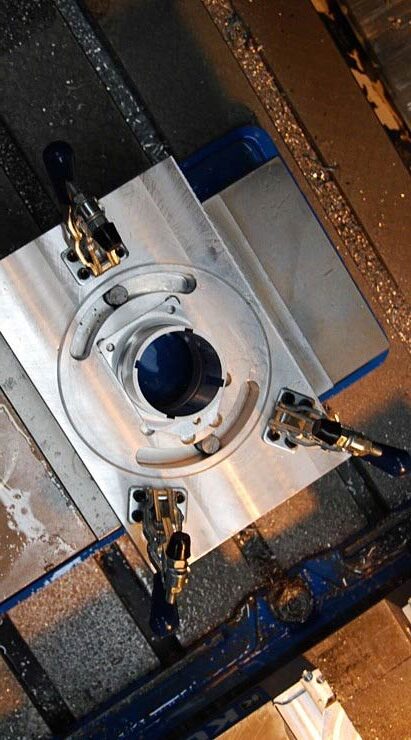
Where Keyways Appear in Power Transmission Assemblies
Internal keyways appear at nearly every shaft-to-hub connection in a drive system:
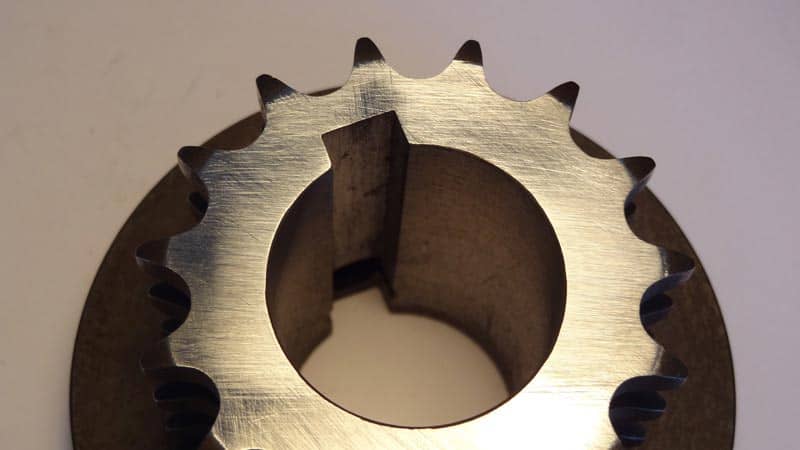
Gear bores — spur gears, helical gears, bevel gears, and worm gears all require internal keyways in their bores to lock onto drive shafts and transmit torque without slipping. Gear bores are often close-tolerance, sometimes blind, and frequently in materials that make broaching difficult or impractical.
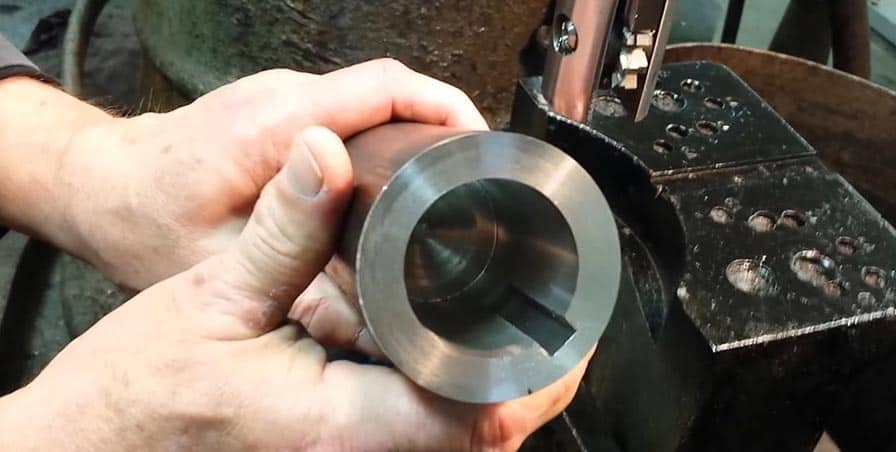
Coupling hubs — flexible couplings, jaw couplings, disc couplings, and rigid couplings all connect to shafts via keyed bores. Coupling hubs are one of the most common NMT applications — the bore is typically blind, the geometry is compact, and the keyway must be accurate to prevent backlash and fretting under cyclic loading.
Sprockets and timing pulleys — chain drive sprockets and synchronous belt pulleys transmit torque through keyed shaft connections. When the bore is non-standard, the material is hardened, or the geometry creates a blind bore, standard broaching runs into problems NMT’s keyseat miller solves directly.
Drive pulleys and sheaves — V-belt and flat belt pulleys mount to shafts via internal keyways. High-speed pulley applications are particularly sensitive to keyway accuracy — an off-center or oversized keyway introduces imbalance that at operating speed becomes vibration, bearing wear, and noise.
Gearbox input and output hubs — inline and right-angle gearboxes have keyed input and output bores that must maintain precise angular alignment under load. Gearbox keyways are often in tight-tolerance, close-ended bores where standard tooling can’t reach.
Clutch and brake hubs — engagement and disengagement mechanisms depend on keyed hub connections that must hold position precisely under rapid load cycling. Keyway accuracy here directly affects engagement timing and component life.
The Power Transmission Keyway Problem
Power transmission keyways carry specific challenges that push standard broaching and EDM toward their limits:
Non-standard bore and keyway combinations — power transmission components come in an enormous range of bore diameters and keyway sizes, including metric, DIN-standard, and custom dimensions. Off-the-shelf broaches exist for common sizes, but anything outside the standard range requires custom tooling — which is slow and expensive to procure and rarely justified for short runs or custom components.
Blind bores in coupling hubs — most coupling hubs have closed-end bores. The bore terminates inside the hub, and the keyway must stop cleanly at the end of the bore without breaking through. Standard broaching requires a relief groove or cross-hole to work in a blind bore — which may not be permitted by the part design, or may weaken a hub that’s already dimensioned to minimum wall thickness for its torque load.
Hardened and specialty materials — power transmission components are frequently made from 4140, 4340, 17-4 stainless, D2 tool steel, and other alloys that are tough on broach tooling and may require EDM if the material is fully hardened. NMT keyseat millers handle most engineering alloys, and the single-pass operation minimizes cutting time in hard materials.
Complete-in-one-setup machining — on CNC production of gears and coupling hubs, moving the part to a separate broaching machine for the keyway operation breaks the setup, re-introduces alignment error, and adds cycle time. NMT keyseat millers load in the CNC carousel and cut the keyway in-program, keeping the part on the fixture from start to finish.
Parallel and opposite keyways — some power transmission applications require two keyways in the same bore at 180 degrees apart, or multiple indexed slots for high-torque tangent key configurations. NMT manufactures tooling for parallel/opposite keyway applications where two keyways must be precisely located relative to each other and to the bore.
Capabilities for Power Transmission Applications
All tooling is custom-manufactured to your application:
- Bore diameters: Under ½” to over 6″ (imperial and metric)
- Keyslot widths: 1/16″ to 2½”
- Keyslot length: Up to 12″ in most materials
- Tolerances: Within ±0.0002″ on width
- Keyway types: Full depth, parallel/opposite (dual keyways, same bore), two-step, V-shaped, radius arc, straight splines
- Blind bores: Full-depth keyways with no relief hole required
- Materials: 1018, 1045, 4140, 4340, 17-4 stainless, D2, A2, Inconel, aluminum, bronze, and most power transmission alloys
- Machine compatibility: Manual drill press, manual mill, horizontal CNC, vertical CNC machining center
- Delivery: Stock tooling ships in 2–3 days; custom tooling in 2–3 weeks
For Gear Manufacturers, Power Transmission OEMs, and Job Shops
Gear and power transmission OEMs use NMT keyseat millers as a standard production tool — loaded in the CNC carousel, called at the keyway operation, and producing repeatable results across production runs without transferring parts to secondary equipment. For non-standard bore and keyway combinations that don’t match available broach inventory, a custom keyseat miller is often faster to procure than a custom broach.
Power transmission distributors and assemblers use them to cut keyways in standard catalog components — gears, couplings, and sprockets supplied with smooth bores — to match specific shaft and key dimensions. This is particularly common when the shaft is metric and the catalog component is imperial, or vice versa.
Job shops bring NMT tooling in-house to eliminate the outsourcing bottleneck on power transmission keyway work. Coupling hubs, gear bores, and sprocket keyways are frequent enough in most shops to justify the tooling but varied enough that a standard broach setup doesn’t cover all the combinations.
Request a Quote for Your Power Transmission Application
Have a gear, coupling, sprocket, or pulley keyway application? Start with your bore diameter, keyway dimensions, material, and whether the bore is blind or through. We quote custom tooling from a print or a sketch and typically respond within one business day.
Call: 513-541-6682 Email: nationalmachinetoolco@gmail.com
National Machine Tool Co. — Cincinnati, OH — Over 100 years manufacturing precision keyseat millers for power transmission and beyond.