
Blind Keyway Milling Without a Relief Hole
A blind bore without a relief hole is one of the hardest keyway applications in machining. Broaching requires a groove or cross-hole at the end of the cut. EDM can take days and cost hundreds of dollars per part. Our keyseat miller solves it in a single pass — no relief hole, no undercut, no part modification required.
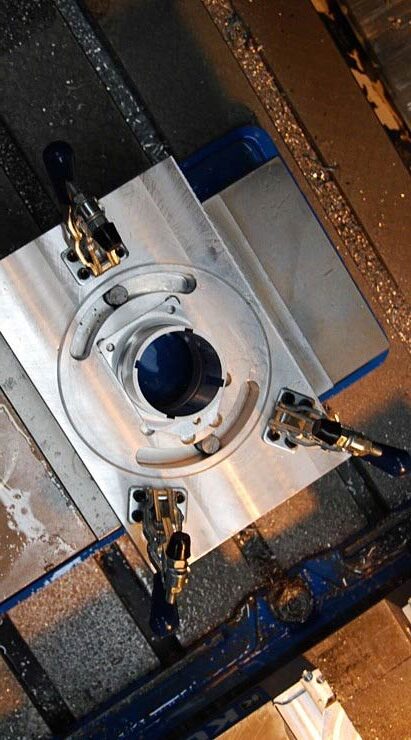
How It Works: Keyway Milling Without Modifying Your Part
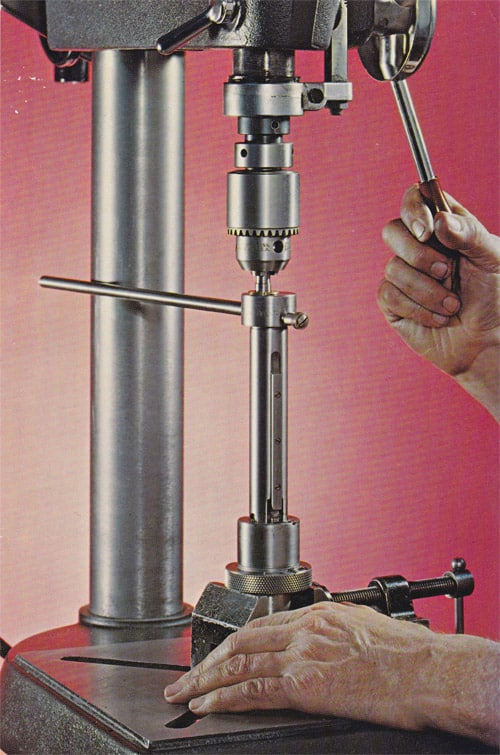
The National Machine Tool keyseat miller uses the bore of your part as its own guide. The tool seats inside the bore, and as it feeds in, a rotating cutter mills the keyway to your specified width and depth in one continuous pass.
Because the tool is guided by the bore wall itself — not by a fixed stop or bushing — there’s no need for chips to exit through a relief groove. The cutter geometry and rotation handle chip management without requiring open air at the end of the bore. The result is a clean, full-depth keyway that terminates inside the bore exactly where it should, with no secondary operations.
This works equally on manual machines and horizontal or vertical CNC machining centers. Setup is the same either way.
Why Relief Holes Aren’t Always an Option
Engineers searching for blind bore keyway solutions are usually here because the standard workarounds don’t work for their part. Common reasons a relief hole isn’t viable:
- The part print doesn’t allow it — the customer’s design spec prohibits additional features
- The bore wall is too thin — drilling a cross-hole would compromise structural integrity
- The geometry doesn’t have room — a shoulder or stepped bore prevents access
- The cost isn’t justified — adding a relief drilling operation just to enable broaching defeats the purpose
- The part is already machined — retrofitting a relief hole means re-fixturing a finished component
If any of these apply to your application, a conventional broaching or CNC broach insert approach will not solve the problem. Our keyseat miller will.
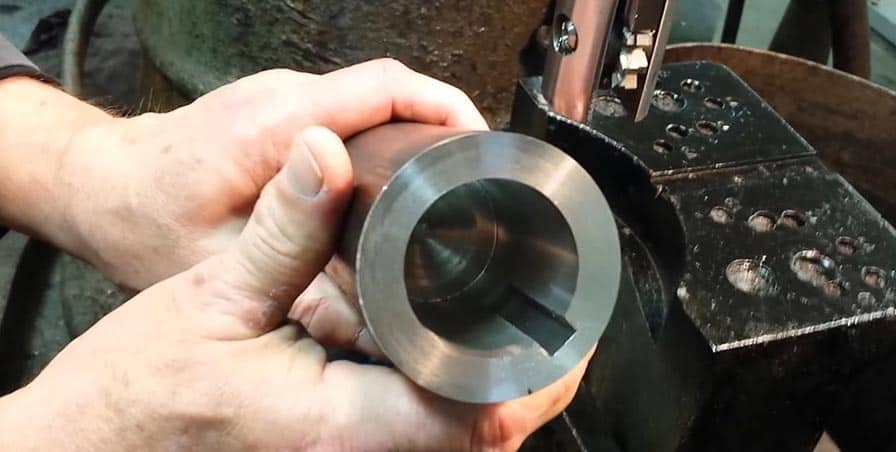
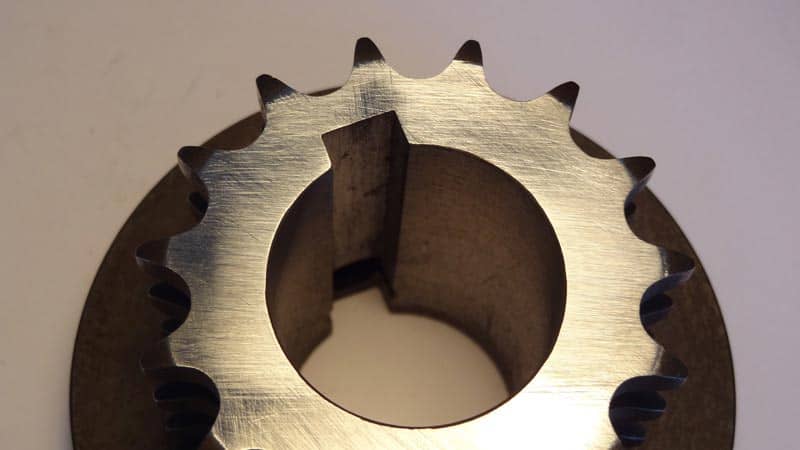
No Relief Hole Required: What That Means in Practice
Our keyseat millers are custom-manufactured to your application. Standard capabilities include:
- Bore diameters: Under ½” to over 6″
- Keyslot widths: 1/16″ to 2½” (all metric sizes also available)
- Keyslot length: Up to 12″ in most materials
- Tolerances: Held to within ±0.0002″ on width
- Keyway types: Full depth, two-step, parallel/opposite, V-shaped, radius arc, straight splines
- Machine compatibility: Manual drill press, manual mill, horizontal CNC, vertical CNC machining center
- Materials: Steel, stainless, aluminum, bronze, cast iron, titanium, and more
- Delivery: Stock items ship in 2–3 days; custom tooling in 2–3 weeks
Every tool is manufactured to your print. We start with your application dimensions and design the tooling around them.
Common Applications for Blind Bore Keyway Milling
Our keyseat millers have been used in blind bore applications across a wide range of industries:
- Pump manufacturing — blind keyways in bronze sleeves, impeller hubs, and pump shafts where bore integrity is critical
- Aerospace & landing gear — internal keyways in strut assemblies and axle shafts where part modification is not permitted by print
- Electric motors & shafts — coupling hubs and motor shafts where a through-bore is not possible
- Food processing equipment — augers, mixer shafts, and conveyor components in stainless steel
- Power transmission — gears, couplings, and clutch hubs requiring precise blind keyways
- Material handling — conveyor pulleys and roller assemblies with closed-end bores
- Pharmaceutical & industrial mixers — tight-tolerance applications in regulated industries
If your application isn’t listed, contact us — our engineers have solved blind bore keyway problems across nearly every industrial sector in over 100 years of manufacturing.

Keyseat Milling vs. EDM vs. Broaching for Blind Bores
| Method | Relief hole required? | Typical lead time | Notes |
|---|---|---|---|
| NMT Keyseat Miller | No | 2–3 days (stock) / 2–3 weeks (custom) | One pass, full depth, manual or CNC |
| CNC broach insert | Yes — groove or cross-hole | Same-day setup | Requires part modification |
| Pull broach | Yes — through bore only | Weeks (custom broach) | Can’t do blind bores at all |
| Wire EDM | No | Days per part | Slow, expensive, no volume efficiency |
| Rotary broach | Recommended | Same-day setup | Undercut strongly advised; depth limited |
| Slotter / shaper | Yes — relief needed | Variable | Low accuracy, slower cycle |
For a true blind bore with no relief feature, keyseat milling is the only method designed for the application from the ground up.
Request a Quote
Have a blind bore application? Start with a print or a sketch. Tell us your bore diameter, keyslot width, and depth — we’ll quote custom tooling and turnaround time from there.
We’ve been manufacturing keyseat millers in Cincinnati, OH for over 100 years. If you have a difficult blind bore application, we’ve likely seen something like it before.