
Broaching Alternatives for Internal Keyways — When Broaching Won't Work
Broaching is fast and cost-effective when conditions are right. But a significant portion of real-world internal keyway applications fall outside what broaching handles well — blind bores, hard materials, short runs, non-standard dimensions, complex bore geometries, or shops that simply don’t have broaching equipment. When broaching won’t work for your application, you need to know what will.
This page covers the practical alternatives to broaching for internal keyways: what each option offers, where it falls short, and when keyseat milling is the right answer.
Why Broaching Doesn't Work for Every Application
Understanding why broaching fails for certain applications makes it easier to choose the right alternative. The most common reasons engineers and machinists look for a broaching alternative:
Blind bore geometry — this is the single most common reason broaching isn’t viable. A push or pull broach needs somewhere to go after completing the cut. Without a through bore or a relief feature at the end — a cross-hole, undercut, or relief groove — the broach has no exit path. Adding a relief feature may not be permitted by the part print, may weaken a thin-walled bore, or may require a drawing revision and engineering approval in regulated industries.
Hard and difficult-to-machine materials — HSS broaches begin losing practical tool life above approximately 35 HRC. By 40–42 HRC, broaching becomes genuinely dangerous — chipped or broken broach teeth, jammed tools, and crashed machines are real risks at that hardness. Heat-treated alloy steels, 17-4 PH stainless, titanium alloys, and Inconel are all commonly encountered power transmission and aerospace materials that push broaching past its practical limit.
Non-standard keyway dimensions — off-the-shelf broaches exist for common keyway sizes in standard bore diameters. Anything outside those standards requires a custom broach, which typically costs $500–$5,000+ and takes weeks to months to procure. For a one-off part or a short production run, custom broach economics rarely make sense.
No broach press or equipment — push and pull broaching requires a dedicated broaching press or a setup on a hydraulic press. Many job shops and manufacturing facilities don’t have this equipment. Improvised broaching on a mill or drill press is unreliable and risks tool or machine damage.
Short runs and prototypes — even where broaching is technically feasible, the economics don’t work for small quantities. The fixed cost of tooling and setup is amortized across the run — for one to ten parts, the per-part cost often exceeds every alternative.
Stepped, threaded, or complex bore geometry — broaches require a clear, unobstructed path through the bore. A shoulder, thread, or reduced-diameter section inside the bore can block the broach entirely, making the method inapplicable regardless of other conditions.
The Main Alternatives to Broaching for Internal Keyways
Keyseat Milling — The Most Practical Alternative for Most Applications
Keyseat milling uses a rotating cutter guided by the bore wall to mill a full-depth internal keyway in a single pass. The tool is custom-manufactured to your bore diameter and keyway dimensions, seats inside the bore, and feeds axially — the bore wall guides the cutter, no external fixture required.
Why keyseat milling replaces broaching for difficult applications:
- Blind bores — no relief hole required. This is the capability no broach-based approach can match without part modification. The keyseat miller mills to full depth in a blind bore, stops cleanly, and retracts. No relief groove, no cross-hole, no undercut needed.
- Works in hard materials. Cutter geometry is specified for your material. NMT tooling has cut keyways in 4140 pre-hard, 4340, 300M, 17-4 PH, titanium alloys, Inconel, and most engineering alloys that exceed broaching’s practical hardness limit.
- Custom dimensions in 2–3 weeks. No $3,000 broach lead time. NMT manufactures tooling to your exact bore diameter and keyway dimensions — metric or imperial, any width from 1/16″ to 2½” — and ships in 2–3 weeks.
- No broach press needed. The keyseat miller runs in a standard drill press (manual machines) or loads from the CNC carousel (machining centers). No dedicated equipment required.
- Short runs and prototypes. One part is enough reason to order custom tooling. The economics work at any quantity.
- Complex bore geometries. Stepped bores, threaded bores, bores with internal shoulders — NMT engineers custom pilot geometry to navigate specific bore configurations that would stop a broach entirely.
- Complete in one CNC setup. On a machining center, the keyway operation runs in-program without moving the part to a secondary machine. The part stays fixtured and the keyway is cut as part of the same program.
Where keyseat milling isn’t the best choice: Very high-volume production of simple, standard keyways in through bores where a broaching line is already set up and running. At true production scale with standard tooling, broaching will have lower per-part cost and faster cycle time. But for everything else — keyseat milling is the answer.
Wire EDM — Last Resort for Extreme Cases
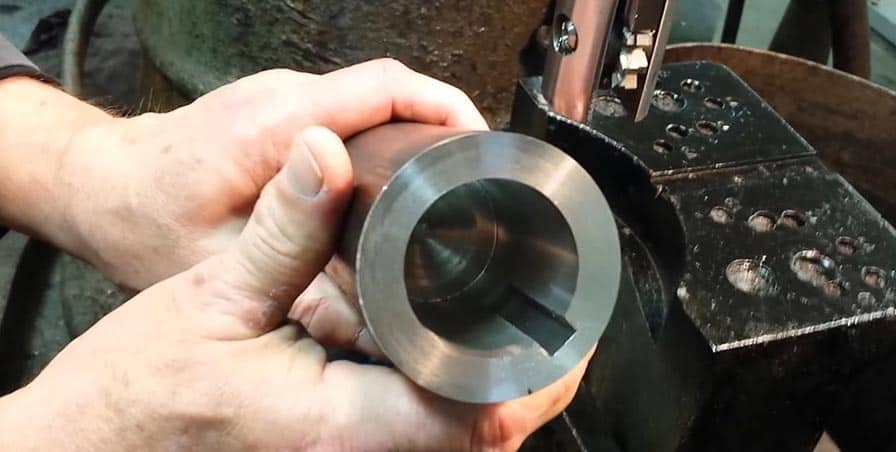
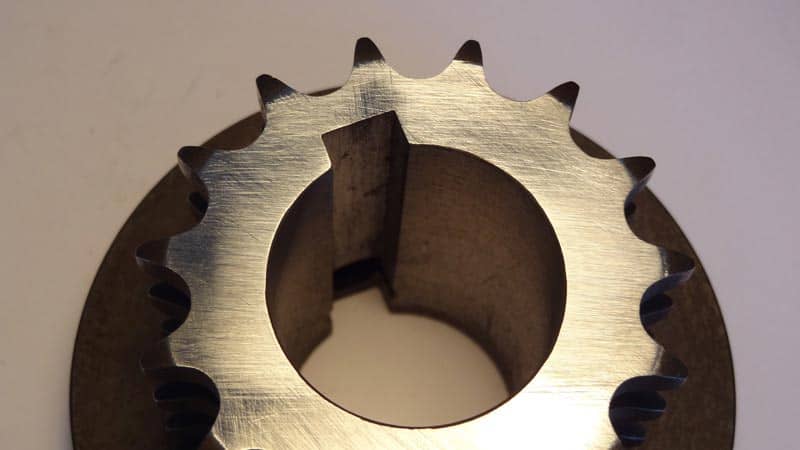
Wire EDM cuts by electrical spark erosion. It doesn’t rely on mechanical cutting force, which means it works regardless of material hardness and can produce any keyway geometry including blind bores. It’s the right answer when no mechanical method is feasible.
When EDM makes sense as a broaching alternative:
- Material is fully hardened and above the practical range for mechanical cutting (above approximately 50–55 HRC)
- The keyway geometry is so unusual that no cutter can be designed for it
- True one-off prototype where EDM machine time is available and cost is acceptable
Where EDM falls short:
- Extremely slow — approximately 12 square inches per hour. A typical blind bore keyway can take hours per part
- High per-part cost makes volume work impractical
- Large or heavy parts may not fit in the machine’s work envelope
- Leaves a recast layer that may need secondary finishing in fatigue-critical applications
EDM is what engineers specify when they’ve exhausted mechanical options. If your application is in a machinable alloy with a conventional blind bore geometry, keyseat milling will almost always be faster and less expensive than EDM. Contact NMT with your material and geometry before defaulting to EDM.
Slotting and Shaping — Legacy Option, Limited Availability
Slotting machines (vertical shapers) use a reciprocating single-point tool that strokes in and out of the bore, removing material gradually until the keyway reaches full depth. It’s one of the original methods for blind bore internal keyways and is technically capable — but slow, less accurate than modern alternatives, and requires equipment that’s increasingly rare in current manufacturing environments.
When slotting might apply:
- Very large bore, large keyway applications where keyseat milling tooling doesn’t exist at the required size
- Shops that already have slotting equipment available
- Applications where dimensional tolerance requirements are moderate
Where slotting falls short:
- Much slower than keyseat milling — many strokes to reach full depth
- Accuracy is limited by single-point tool deflection, especially in deep keyways
- Setup and alignment is skill-dependent and time-consuming
- Dedicated slotting machines are uncommon in modern shops
For most applications where slotting is technically viable, keyseat milling is faster, more accurate, and easier to set up on equipment the shop already has.
Improvised Methods — When Nothing Else Is Available
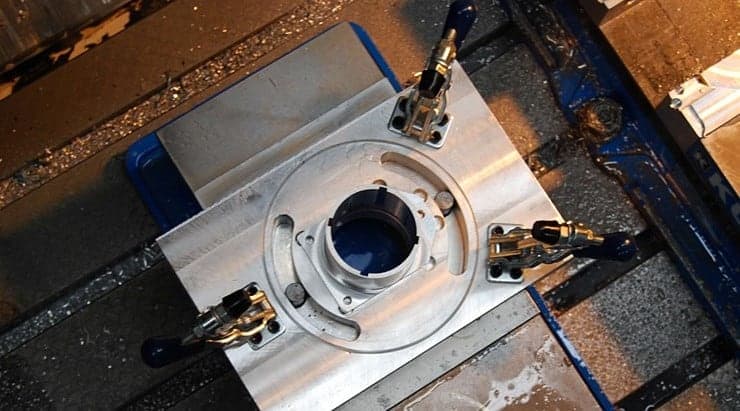
When proper tooling isn’t available and the part is needed immediately, machinists sometimes resort to improvised approaches:
Lathe-shaping with a ground boring bar tool — a square-ground tool held in the boring bar holder, advanced manually through the bore in a lathe. Slow, skill-dependent, difficult to hold tolerance. Works for one-off rough applications where dimensional accuracy is not critical.
Hand filing — only practical for very small, low-tolerance keyways in soft materials. Not a real manufacturing solution.
Milling from the end of a through bore with an end mill — works in some through-bore configurations where the mill can reach the keyway position. Not applicable to blind bores.
These approaches exist for field repairs and emergency situations. For any production work or precision application, order the right tooling.
Choosing the Right Broaching Alternative
Work through these questions:
Is the bore blind without a relief feature? → Broaching is not viable. Keyseat milling is the primary option. EDM as a fallback in extreme hardness cases.
Is the material above 40–42 HRC? → Broaching becomes impractical. Keyseat milling with material-specific cutter geometry handles most alloys in this range. EDM for cases above approximately 50–55 HRC.
Is this a short run, prototype, or non-standard keyway dimension? → Keyseat milling. Custom tooling in 2–3 weeks at a fraction of custom broach cost and lead time.
Does the bore have complex geometry — steps, threads, internal shoulders? → Keyseat milling with custom pilot geometry designed around the specific bore configuration. Often the only practical mechanical option.
Don’t have a broach press? → Keyseat milling runs on a drill press or CNC machining center. No specialized equipment needed.
High-volume, simple, standard keyway, through bore, soft material, already have tooling? → Broaching is probably already your answer. If you’re reading this page, it may not be.
Bringing Keyway Work In-House Without a Broach Press
One of the most common conversations NMT has with job shops and manufacturers is about bringing keyway work in-house that’s currently being outsourced to broaching houses or EDM shops. The economics of outsourcing add up quickly — lead time, freight, per-part premiums, and the scheduling dependency on an outside vendor.
A custom NMT keyseat miller eliminates the outsourcing dependency for the specific bore and keyway dimensions it’s built for. The tool runs on equipment you already have, ships in 2–3 weeks, and pays for itself quickly on applications that were previously sent out.
If you’re regularly outsourcing keyway work — especially blind bore, hard material, or non-standard dimension applications — it’s worth having a conversation about whether in-house tooling makes sense for your volume and application mix.
Request a Quote
Have a keyway application where broaching isn’t working? Tell us your bore diameter, keyway dimensions, material, and bore geometry (blind or through). We’ll tell you directly whether a keyseat miller is the right solution and quote custom tooling from there.
Call: 513-541-6682 Email: nationalmachinetoolco@gmail.com
National Machine Tool Co. — Cincinnati, OH — Over 100 years manufacturing custom keyseat millers for the applications broaching can’t handle.