
How Internal Keyways Are Machined — Methods, Tools, and Comparisons
Internal keyways are one of the most common precision features in mechanical assemblies — and one of the most frequently misunderstood from a process standpoint. An external keyway on a shaft is straightforward. An internal keyway inside a bore is a different problem: limited tool access, chip evacuation constraints, blind bore geometry, and tight tolerances all influence what method is actually feasible for a given application.
This guide covers every practical method for machining internal keyways — how each one works, where it excels, where it fails, and how to choose the right approach for your application.
What Is an Internal Keyway?
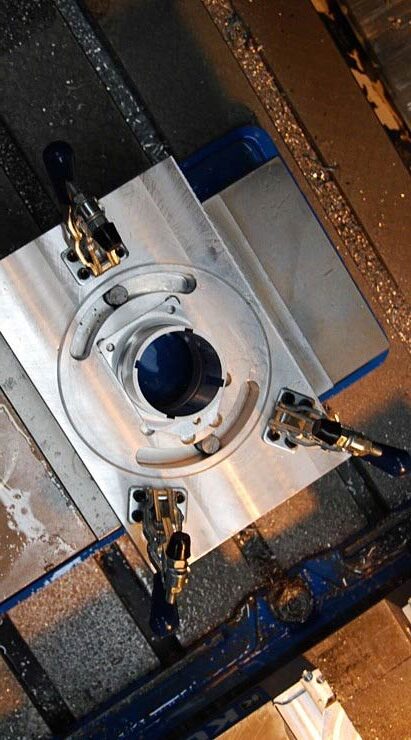
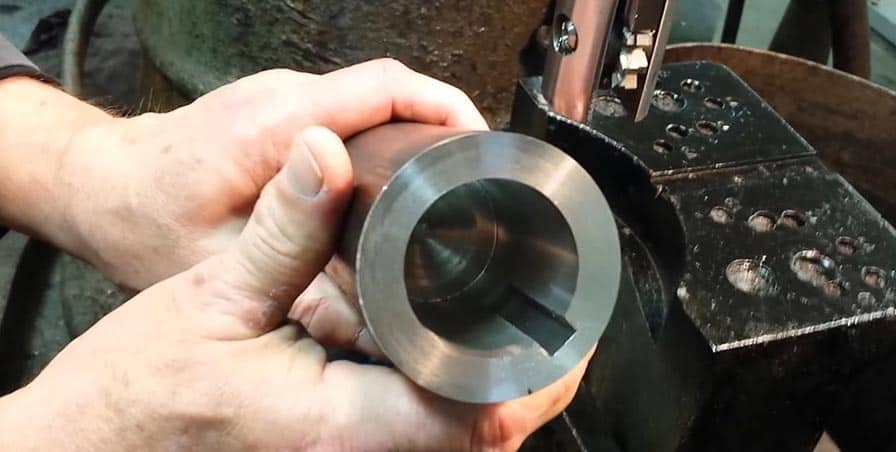
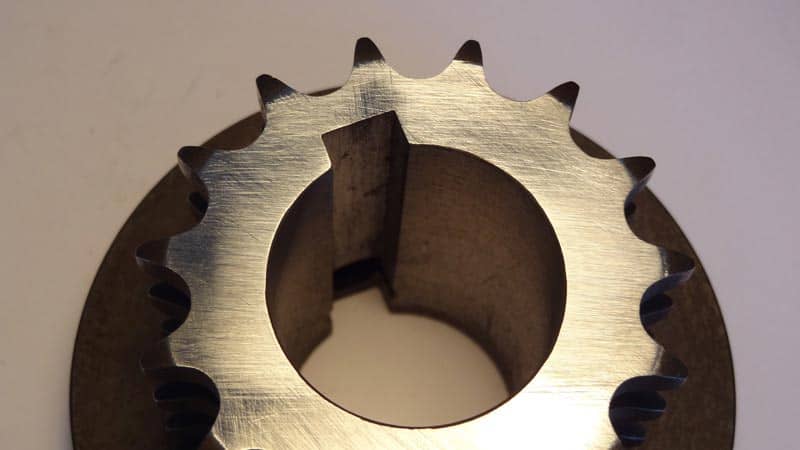
An internal keyway is a longitudinal slot machined inside a bore — typically in a gear, coupling hub, pulley, sprocket, or sleeve — that accepts a mating key to lock the component to a shaft and transmit torque. The keyway and key together prevent relative rotation between the shaft and the hub under load.
Internal keyways are defined by four dimensions: width, depth, length, and position (angular orientation within the bore). All four must be held to tolerance for the assembly to function correctly. A keyway that’s too wide allows the key to rock under cyclic loading, accelerating fretting wear. One that’s too shallow reduces key bearing area and increases shear stress. One that’s off-center introduces misalignment in the assembly.
The challenge with internal keyways — as opposed to external keyways on shafts — is that the tool must enter the bore and operate within its geometry. That constrains tool size, cutting direction, chip path, and in blind bore applications, where chips can go at the end of the cut.
The Four Main Methods for Machining Internal Keyways
1. Broaching
Broaching uses a multi-tooth cutting tool — the broach — that is pushed or pulled linearly through a pre-drilled bore. Each successive tooth is slightly deeper than the last, removing a small amount of material per tooth until the keyway is at full depth. The entire keyway is produced in one stroke.
How it works in practice: The part is fixtured on a broaching press (vertical or horizontal). A guide bushing is inserted into the bore to align the broach on centerline. The broach is pressed through — the process takes seconds per part once set up. For production runs, it’s fast and consistent.
Where broaching works well:
- High-volume production of identical parts with standard keyway sizes
- Through bores where the broach can exit the opposite end
- Softer materials (1018, 1045, aluminum, bronze) where HSS broach life is acceptable
- Applications where off-the-shelf broach sizes match the required keyway
Where broaching runs into problems:
- Blind bores — a push or pull broach requires somewhere to go after the cut. Without a relief groove, cross-hole, or undercut at the end of the bore, broaching is not possible
- Non-standard keyway sizes — custom broaches are expensive ($500–$5,000+) and take weeks to manufacture. Low-volume or custom work rarely justifies the tooling investment
- Hard materials — HSS broaches begin losing practical life above approximately 35 HRC. Carbide insert broaching tools extend this range to approximately 40–42 HRC, but above that, crashes and insert failure become real risks
- Thin-walled parts — the guide bushing required for broach alignment needs bore wall to bear against; thin walls can deflect or crack under broaching load
Bottom line: Broaching is the right choice for simple, high-volume, through-bore, standard-size applications. It’s not flexible enough for difficult geometry, blind bores, or custom work.
2. Wire EDM (Electrical Discharge Machining)
Wire EDM cuts by eroding material with rapid electrical sparks from a thin copper or brass wire. The wire doesn’t contact the workpiece directly — the discharge jumps a small gap and ablates material, leaving a precise cut path. Because cutting force is essentially zero, wire EDM works in any material regardless of hardness.
How it works in practice: The part is submerged in dielectric fluid. The wire is threaded through a pre-drilled start hole and the machine follows a programmed path, cutting the keyway profile by spark erosion. Cycle times depend on material, cut depth, and cross-sectional area — a typical rate is approximately 12 square inches per hour.
Where EDM works well:
- Hard and exotic materials at any hardness — fully hardened tool steel, Inconel, titanium, carbide
- True blind bores where no mechanical cutting tool can be designed for the geometry
- Complex non-standard keyway profiles that no cutter geometry can produce
- One-off prototypes where accuracy matters more than speed or cost
- Applications where no other method is feasible
Where EDM runs into problems:
- Speed — at 12 square inches per hour, EDM is slow. A 6″ deep keyway at typical bore widths can take hours per part. For any production volume, the cycle time economics rarely work
- Cost — EDM shops charge premium rates for internal keyway work; per-part costs at volume make it impractical for regular production
- Part size — wire EDM machines have physical envelope limits. Large or heavy parts (landing gear, large pump housings) may not fit in the machine’s work zone
- Recast layer — EDM leaves a thin recast layer on the cut surface that may require secondary finishing in precision or fatigue-critical applications
Bottom line: EDM is the last resort — for applications where nothing else works. If a colleague or vendor has specified EDM for a blind bore keyway in a machinable alloy, it’s worth asking whether keyseat milling could do the same job faster and cheaper.
3. Slotting and Shaping
Slotting machines (also called keyseaters in the traditional sense) and shapers use a reciprocating single-point cutting tool that strokes in and out of the bore, removing a small amount of material per stroke. The tool advances slightly on each stroke until the keyway reaches full depth.
How it works in practice: The part is fixtured under the slotting head. The cutting tool is aligned to the bore centerline, and the machine strokes repeatedly — often hundreds of strokes for a full-depth keyway. It’s slow but doesn’t require through-bore access, making it one of the older solutions for blind keyways.
Where slotting works well:
- Blind bore applications where broaching isn’t possible and EDM isn’t available
- Large bore, large keyway applications where other tooling doesn’t exist at that size
- Repair and one-off work in a shop that has a slotter
- Situations where dimensional accuracy requirements are moderate
Where slotting runs into problems:
- Speed — slotting is significantly slower than broaching and keyseat milling
- Accuracy — without a fixed guide, single-point tools are subject to deflection, which makes holding tight keyway tolerances (±0.0002″) difficult across the full length of a deep keyway
- Machine availability — dedicated slotting machines are increasingly rare in modern machine shops
- Setup time — aligning the tool to the bore centerline requires skill and time
Bottom line: A viable option for large bore, blind bore, one-off work in shops that have the equipment. Not practical for production work or applications requiring tight tolerances.
4. Keyseat Milling
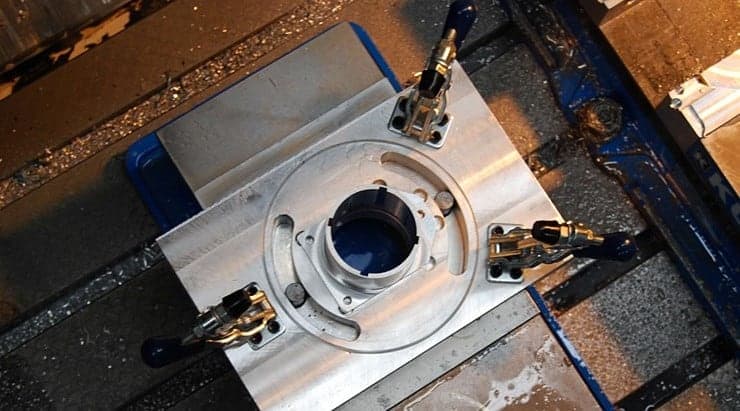
Keyseat milling uses a rotating cutter guided by the bore wall itself to mill a full-depth keyway in a single pass. The tool is custom-manufactured to the specific bore diameter and keyway dimensions, seats inside the bore with the bore wall acting as the guide, and feeds axially as the cutter rotates — milling the keyway to full width and depth in one continuous movement.
How it works in practice: The keyseat miller mounts in a standard drill chuck, collet, or CNC tool holder. It loads like any other tool — manual machines or CNC carousel — and is fed into the bore at the appropriate speed. Because the bore wall guides the tool, no external fixture or guide bushing is required. In a CNC machining center, the keyway operation is a programmed tool change and Z-axis feed — the part doesn’t need to move.
Where keyseat milling works well:
- Blind bores without relief holes — the tool’s defining advantage. No relief groove, cross-hole, or undercut is required
- Non-standard and custom keyway dimensions — NMT manufactures tooling to exact specifications; bore diameter, keyway width, depth, and length are all custom
- Short runs and prototypes — custom tooling ships in 2–3 weeks at a fraction of custom broach cost
- Hard and difficult-to-machine materials — 4140, 4340, 300M, 17-4 stainless, Inconel, titanium — cutter geometry is specified for the material
- Complete-in-one-setup CNC machining — the tool runs in-program without moving the part to a secondary machine
- Complex bore geometries — stepped bores, threaded bores, bores with internal shoulders — custom pilot geometry navigates the specific configuration
- Manual machine shops — works on a standard drill press or Bridgeport at approximately 900 RPM, no CNC required
Where keyseat milling is not the ideal choice:
- True high-volume production of simple standard keyways in through bores — at production scale with a standard geometry, a broaching line will have lower cycle time and per-part cost
- When an off-the-shelf broach already exists for the exact application and the bore is a through bore
Bottom line: The most flexible internal keyway method available. The only method that handles blind bores without part modification. Correct for most custom, difficult, or non-standard applications.
Full Comparison
| Broaching | Wire EDM | Slotting | Keyseat Milling | |
|---|---|---|---|---|
| Blind bores — no relief | No | Yes | Partial | Yes |
| Through bores | Yes | Yes | Yes | Yes |
| Hard materials (40+ HRC) | No | Yes | No | Yes |
| Custom / non-standard sizes | Slow & costly | Yes | Limited | Yes — 2–3 weeks |
| Short runs (1–10 parts) | Poor | Acceptable | Acceptable | Good |
| High-volume production | Best | Poor | Poor | Good |
| No part modification needed | No | Yes | Partial | Yes |
| Manual machine compatible | No | No | Yes | Yes |
| CNC machining center | With limitations | No | No | Yes |
| Tolerance capability | High | Very high | Medium | High (±0.0002″) |
| Tooling lead time (custom) | Weeks to months | N/A | Days | 2–3 weeks |
| Relative per-part cost (volume) | Low | High | Medium | Medium |
How to Choose the Right Method
Work through these questions in order:
Is the bore blind with no relief feature? If yes — broaching and standard slotting are eliminated. Your options are EDM or keyseat milling. In almost all cases, keyseat milling is faster and less expensive.
Is the keyway a standard size in a through bore at production volume? If yes — broaching is likely the right answer. The economics are hard to beat for simple, high-volume, standard applications.
Is the material above 40–42 HRC? If yes — HSS and most carbide broaching becomes impractical. EDM works at any hardness. Keyseat milling can work depending on the alloy and specific hardness — contact NMT with your material to confirm feasibility.
Is this a short run, prototype, or non-standard keyway dimension? If yes — keyseat milling. Custom broach lead time and cost aren’t justified. EDM is an option but slow and expensive for anything beyond a single part.
Does the bore have complex geometry — steps, threads, shoulders? If yes — keyseat milling with a custom pilot designed around the specific bore configuration is typically the only practical mechanical solution. EDM as a fallback.
About NMT Keyseat Millers
National Machine Tool has been manufacturing custom keyseat millers for internal keyway applications since the early 1900s. Our tools are used across industries — pump manufacturing, aerospace, power transmission, electric motors, food processing, and more — wherever engineers need a reliable, precise internal keyway in a bore that standard tooling can’t handle.
We manufacture to your application: bore diameter, keyway dimensions, material, and machine type. Stock tooling ships in 2–3 days. Custom tooling in 2–3 weeks.
Call: 513-541-6682 Email: nationalmachinetoolco@gmail.com