
Keyseat Milling vs. Broaching vs. EDM: Choosing the Right Method for Internal Keyways
When you need an internal keyway, you have a handful of process options — and the right choice depends heavily on your bore geometry, material, volume, and whether you can modify the part. This page breaks down the three most common methods engineers and machinists consider: broaching, wire EDM, and keyseat milling. We’ll be direct about where each method wins and where it falls short.
The Short Version
If you have a through bore, high volume, and a standard keyway size — broaching is probably your best option. Fast, repeatable, low per-part cost at scale.
If you have a blind bore, no relief hole, a difficult material, or a non-standard geometry — keyseat milling is almost certainly the right answer. It’s what NMT has been building custom tooling for since the early 1900s.
If you have a true one-off, exotic material, or a geometry nothing else can touch — wire EDM may be your only option, but you’ll pay for it in time and cost.
Method 1: Broaching
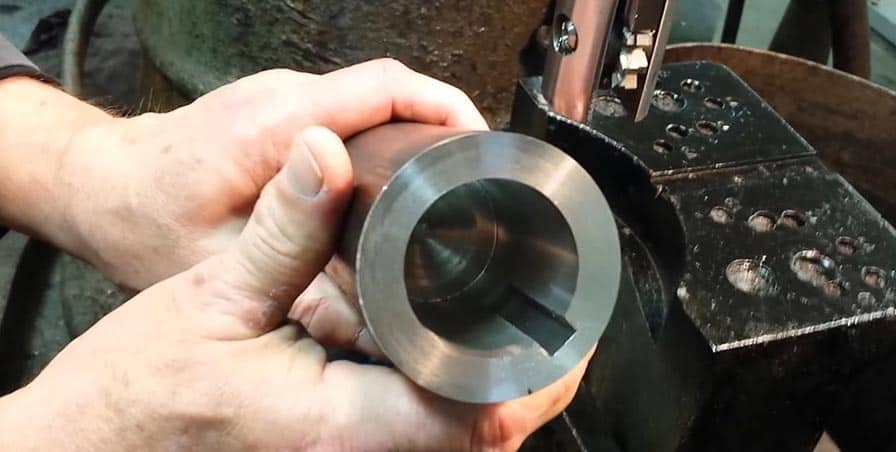
Broaching uses a multi-tooth cutting tool — the broach — that is pushed or pulled through a bore, with each successive tooth removing a small amount of material until the keyway is cut to full depth. It’s fast, accurate for standard geometries, and cost-effective at volume.
Where broaching works well:
- Through bores where the tool can exit the other side
- High-volume production runs where tooling cost is amortized across many parts
- Standard keyway sizes where off-the-shelf broaches exist
- Softer materials like mild steel and aluminum where broach life is reasonable
Where broaching runs into problems:
- Blind bores — a standard pull or push broach cannot cut a blind keyway. It needs somewhere to go once it exits the cut. Workarounds (relief grooves, cross-holes, undercuts) are required and may not be permitted by the part print
- Custom tooling cost and lead time — a custom broach for a non-standard keyway can cost $1,000–$5,000+ and take weeks to procure. For short runs or prototypes, this rarely makes economic sense
- Hard and exotic materials — broaching titanium, hardened steel, Inconel, and similar materials is hard on tooling and often impractical
- Part modification — if the bore doesn’t have a relief feature, you have to add one. That may require a drawing revision, a secondary operation, and in regulated industries like aerospace, engineering approval
Bottom line on broaching: the right choice for simple, high-volume, through-bore applications with standard keyway sizes. Not flexible enough for difficult geometry, blind bores, or low-volume custom work.
Method 2: Wire EDM
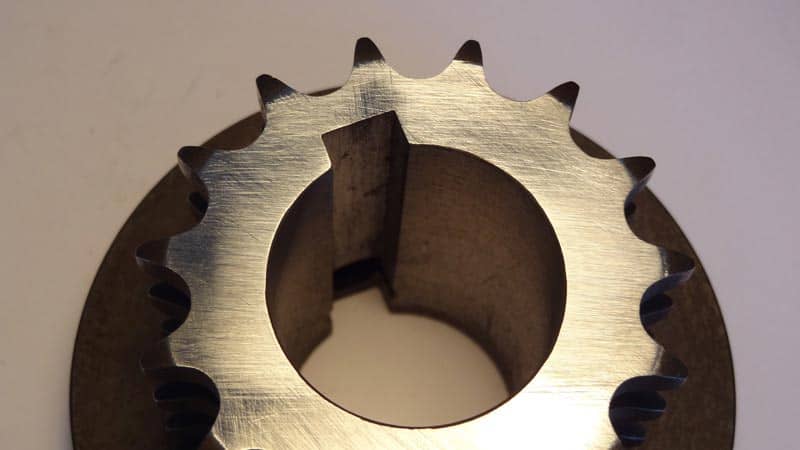
Wire EDM (electrical discharge machining) cuts material by passing a thin wire close to the workpiece and eroding metal through a series of rapid electrical sparks. It’s highly accurate and can cut nearly any geometry in nearly any material regardless of hardness — but it’s slow.
Where wire EDM works well:
- True blind bores with no other machining option
- Very hard materials (fully hardened tool steel, carbide, Inconel) that would destroy conventional cutting tools
- Complex or non-standard keyway profiles that no standard cutter can produce
- Low-volume prototype work where accuracy matters more than speed
- When no other method is feasible
Where wire EDM runs into problems:
- Speed — a standard wire EDM machine cuts at roughly 12 square inches per hour. On a 6″ deep bore, that’s about 2″ of depth per hour. For anything beyond a one-off, the cycle time per part is prohibitive
- Cost — EDM shops typically charge significant per-part premiums for blind keyway work. For production volumes, the economics rarely work
- Part size — wire EDM machines have physical envelope limits. Very large landing gear components, long shafts, or heavy pump housings may not fit
- Chip and debris — EDM leaves a recast layer on the cut surface that may need to be addressed in precision applications
Bottom line on wire EDM: a last resort for applications that nothing else can handle. Accurate but slow and expensive. If your engineer specified EDM on a blind bore application, it’s worth asking whether keyseat milling could achieve the same result at a fraction of the cost and lead time.
Method 3: Keyseat Milling
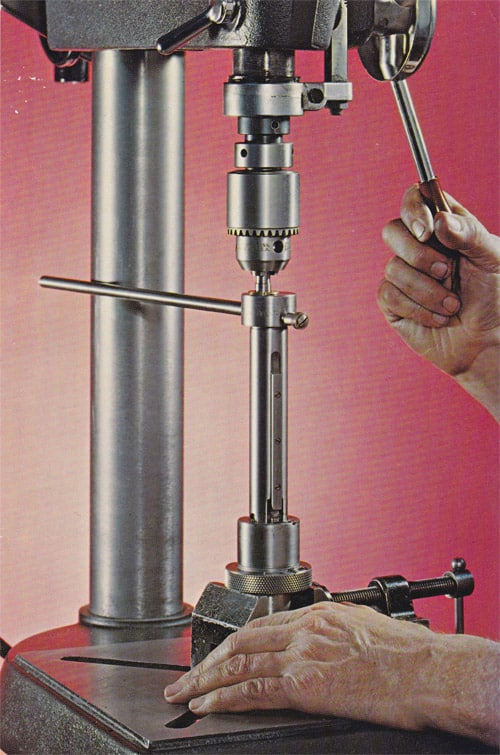
Keyseat milling uses a rotating cutter guided by the bore itself to mill a full-depth keyway in a single pass. The tool is custom-manufactured to your bore diameter and keyway dimensions, seats inside the bore, and feeds axially — with the bore wall acting as the guide that keeps the cutter on centerline.
This is what NMT’s keyseat millers do, and it’s why pump manufacturers, aerospace suppliers, motor OEMs, and job shops have been ordering custom tooling from NMT for over a century.
Where keyseat milling works well:
- Blind bores without relief holes — this is keyseat milling’s defining advantage. The tool doesn’t need a relief groove, undercut, or cross-hole to cut a blind keyway. No part modification required
- Non-standard and custom keyway sizes — NMT manufactures tooling to your exact dimensions. Keyslot widths from 1/16″ to 2½”, bore diameters from under ½” to over 6″, metric and imperial
- Short runs and prototypes — custom tooling ships in 2–3 weeks. No $3,000 broach required for a 5-piece run
- Difficult materials — bronze, stainless, titanium, 300M, 4140, Inconel, and most engineering alloys
- CNC machining centers — the tool loads in a standard tool holder and runs from the program without moving the part to a secondary machine
- Complete-in-one-setup machining — keep the part fixtured and finish the keyway in the same program as the rest of the machining
- Complex bore geometries — stepped bores, threaded bores, bores with internal shoulders — NMT engineers custom pilot geometry to navigate specific bore configurations
Where keyseat milling is not the right choice:
- Very high volume production of simple through-bore, standard keyway parts where broaching cycle time and per-part cost are optimized. At true production scale with a standard geometry, a broaching line will be faster
- If an off-the-shelf broach already exists for your application and the bore is a through bore, broaching may be faster to set up
Bottom line on keyseat milling: the most flexible internal keyway method available. The only method that handles blind bores without part modification. The right choice for most custom, difficult, or non-standard applications.

Side-by-Side Comparison
| Broaching | Wire EDM | Keyseat Milling | |
|---|---|---|---|
| Blind bores — no relief | No | Yes | Yes |
| Through bores | Yes | Yes | Yes |
| Custom / non-standard sizes | Slow & expensive | Yes | Yes — 2–3 weeks |
| Hard materials | Limited | Yes | Yes |
| Short runs (1–10 parts) | Poor economics | Acceptable | Good |
| High-volume production | Best | Poor | Good |
| No part modification needed | No | Yes | Yes |
| Works on manual machines | No | No | Yes |
| Works on CNC machining center | With limitations | No | Yes |
| Typical lead time (custom) | Weeks to months | Days (per part) | 2–3 weeks |
How to Choose
Use broaching if: you have a standard keyway size, a through bore, high volume, and an existing broach. The economics are hard to beat at scale for simple applications.
Use wire EDM if: nothing else works. The bore is truly inaccessible, the material is too hard for cutting tools, or the geometry is so unusual that no cutter can be designed for it. Accept the time and cost.
Use keyseat milling if: you have a blind bore, a non-standard keyway, a difficult material, a part print that doesn’t allow modification, a short run, or you want to complete the keyway operation on your existing CNC without a part transfer. This covers the majority of difficult internal keyway applications.
Request a Quote for Your Keyway Application
If you’re evaluating options for an internal keyway application, NMT can tell you quickly whether keyseat milling is the right fit. Send us a print or a sketch with your bore diameter, keyway dimensions, material, and any geometric constraints.
Call: 513-541-6682 Email: nationalmachinetoolco@gmail.com
National Machine Tool Co. — Cincinnati, OH — Over 100 years manufacturing custom keyseat millers.