
Parallel and Opposite Keyway Milling — Multiple Internal Keyways in One Bore
Most internal keyway applications involve a single slot. Some don’t. When a design calls for two keyways 180° apart in the same bore, four keyways at 90° intervals, or any multiple-slot configuration in an internal bore — the machining challenge gets significantly more complex. You need consistent angular indexing between slots, accurate location relative to the bore centerline, and a method that works in blind bore geometry without a relief hole.
NMT manufactures custom keyseat millers for parallel, opposite, and multi-slot internal keyway applications. It’s a capability we’ve been engineering solutions for across industries — parts manufacturing, power transmission, aerospace, and others — wherever a design requires more than one internal keyway in the same bore.
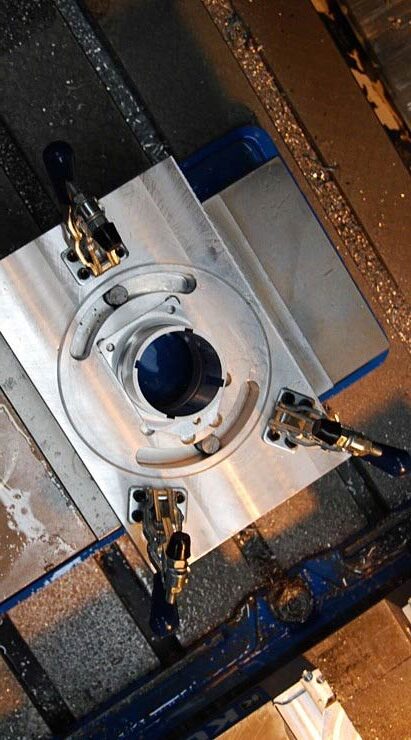
Why Multiple Internal Keyways Are Used
Multiple keyways in the same bore appear for specific engineering reasons:
Load distribution — a single key concentrates the torque load on one point of contact between the hub and shaft. Two opposite keyways and keys share that load across two contact surfaces, reducing stress on each key and keyway and extending component life under high or reversing torque loads.
Angular indexing — some assemblies require the hub to be locked to the shaft at a specific angular position, or to be assembled in only one orientation. Multiple keyways at indexed positions ensure the component can only be installed correctly.
High-torque power transmission — couplings, gearbox flanges, and large pump impellers in high-torque applications sometimes require two or more keys to transmit load that a single key cannot handle reliably.
Anti-rotation in precision assemblies — two opposite keyways prevent any rocking or rotation of the hub relative to the shaft that a single keyway might allow under alternating load directions.
Redundancy in critical applications — aerospace and defense applications sometimes specify dual keyways as a design redundancy measure, ensuring the assembly remains locked even if one key fails.
The Machining Challenge
Cutting a single internal keyway is difficult. Cutting two or more in the same bore — accurately indexed relative to each other — adds several layers of complexity:
Angular accuracy between slots — for two opposite keyways to function correctly, they must be located at precisely 180° from each other, not 178° or 182°. Any angular error means the keys won’t fit simultaneously, or the hub will be pre-loaded asymmetrically on assembly.
Consistent depth across slots — both keyways must be at the same depth and width. Variation between slots creates differential key fit, which causes one key to carry more load than the other.
Indexing in a blind bore — for external shaft keyseats, indexing between cuts is straightforward. For internal keyways in a blind bore, the tool must re-enter the bore for each slot, and the part must be indexed without losing reference to bore centerline.
Standard tooling doesn’t address this — off-the-shelf broaches are single-slot tools. Cutting two internal keyways with a standard broach means two separate setups, two guide bushings aligned independently, and two chances for angular error to accumulate. In a blind bore, broaching multiple slots is even harder.
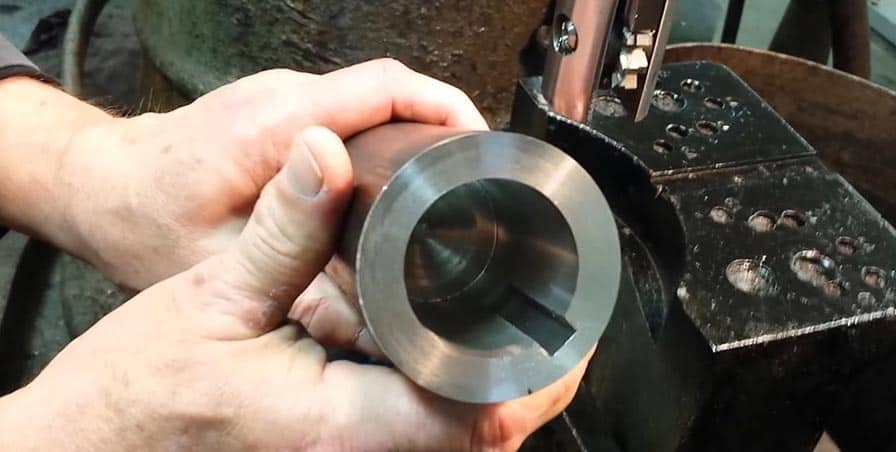
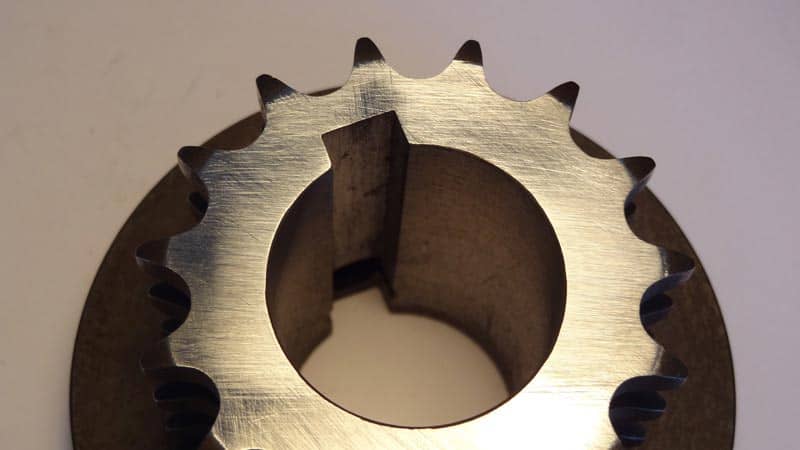
How NMT Solves It
Two Opposite Keyways (180° Apart) — Center-Mounted Cutter
For applications requiring two internal keyways at 180° from each other, NMT manufactures a keyseat miller with a center-mounted cutter. The cutter is positioned at the center of the tool body rather than at the end, and as the tool feeds into the bore, it mills two slots simultaneously — one on each side of the bore — using climb milling on one side and conventional milling on the other.
The result: both keyways are cut in a single pass, with the angular relationship between them determined by the tool geometry rather than by part fixturing or indexing. Angular accuracy between the two slots is inherent to the tool — not dependent on setup.
This approach is used for dual-keyway coupling hubs, high-torque gear bores, and any application where two opposite internal keyways must be precisely located relative to each other.
Four Keyways at 90° Intervals — Two-Pass with Indexing
For applications requiring four keyways at 90° intervals in the same bore — like the parts manufacturing application in our capabilities — the center-mounted cutter mills two opposite slots in the first pass. The customer then indexes the part 90° and runs the second pass, producing the remaining two slots.
A real example from our capabilities: A parts manufacturer needed four internal keyways at 90° apart in a blind bore without a relief hole. The keyway dimensions were 0.215″ wide by 0.100″ deep. NMT designed a special keyseat miller with a center-mounted cutter that milled two slots per pass — climb milling on one side, conventional milling on the other. After the first pass, the customer indexed the part 90° and repeated. Four precise, evenly spaced keyways in a blind bore, produced in two passes with no secondary machine required.
Custom Angular Configurations
For applications requiring keyways at angles other than 180° or 90° — 120° for three-keyway configurations, 60° for six-slot spline-like arrangements, or custom indexed positions — NMT engineers custom tooling for the specific angular geometry. Contact us with your configuration and we’ll work through the feasibility.
Applications for Parallel and Opposite Keyway Milling
High-torque coupling hubs — large couplings in pump, compressor, and gearbox applications where a single key is insufficient for the torque load. Two opposite keyways double the key contact area and distribute load symmetrically.
Precision gear bores — gears requiring exact angular positioning relative to other drivetrain components, where multiple keyways lock the assembly in the correct orientation.
Power generation components — turbine and generator coupling flanges where load distribution across multiple keys is specified by design.
Aerospace actuator components — dual keyways as a design redundancy measure in flight-critical actuator hubs and linkage assemblies.
Parts manufacturing production runs — high-volume hub and coupling components with multiple keyway configurations that need to be produced repeatably without secondary operations.
Custom mechanical assemblies — any application where the bore geometry, torque load, or design requirement calls for more than one internal keyway.
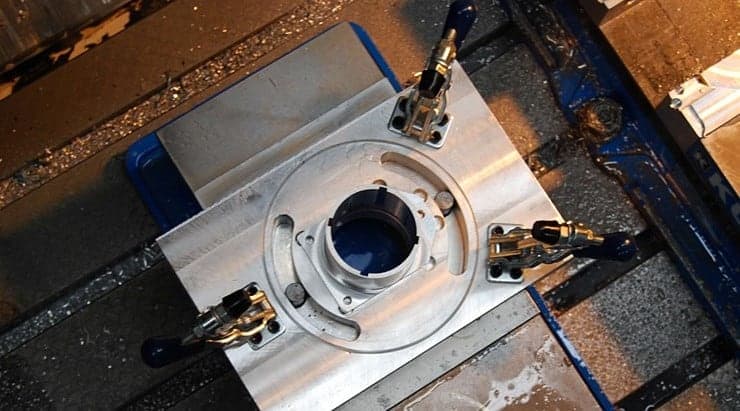
Capabilities for Multiple Keyway Applications
All tooling is custom-manufactured to your application:
- Configurations: Two opposite keyways (180°), four keyways (90° intervals), three keyways (120°), and custom angular configurations — contact us to discuss
- Bore diameters: Under ½” to over 6″
- Keyslot widths: 1/16″ to 2½” (metric and imperial)
- Keyslot length: Up to 12″ in most materials
- Tolerances: Within ±0.0002″ on width; angular relationship between slots determined by tool geometry
- Blind bores: Full-depth multiple keyways without a relief hole
- Materials: Steel, stainless, aluminum, bronze, titanium, and most engineering alloys
- Machine compatibility: Manual drill press, manual mill, horizontal CNC, vertical CNC machining center
- Delivery: Custom tooling typically ships in 2–3 weeks
Why Not Broach Multiple Keyways?
Standard keyway dimensions for common shaft diameters — for reference only; always verify against your specific print and fit class requirement.
The standard answer for multiple internal keyways is a special double-broach or sequential single broaches with indexed guide bushings. In practice this approach has real limitations for difficult applications:
A double-broach for opposite keyways requires a guide bushing aligned to both keyway positions simultaneously — which adds setup complexity and another source of angular error. In blind bores, chips have nowhere to exit on the second pass without a relief feature. Custom double broaches are expensive to procure and inflexible if the keyway dimensions change. And for four or more keyways, the progressive broach approach requires multiple setups with independent alignment for each pass.
NMT’s center-mounted cutter approach eliminates the angular indexing problem between opposite keyways by design — the tool geometry determines the relationship between the two slots, not the fixturing. Two passes handles four keyways at 90° intervals without any intermediate realignment.
Request a Quote for Your Multiple Keyway Application
Have a bore with two or more internal keyways? Send us the bore diameter, number of keyways, angular spacing, keyway dimensions, material, and whether the bore is blind or through. We’ll confirm feasibility and quote custom tooling from there.
Call: 513-541-6682 Email: nationalmachinetoolco@gmail.com
National Machine Tool Co. — Cincinnati, OH — Over 100 years manufacturing custom keyseat millers, including parallel, opposite, and multi-slot configurations that standard tooling can’t handle.